Evidence synthesis is highly valuable when information is incomplete or difficult to compare. In these situations, the challenge is not only to produce a reliable answer to a question, but to outline how we got to that answer and to communicate uncertainty.
Although much of our work focuses on making the most of available data to support biodiversity conservation, the same principles apply in other scientific disciplines.
Context
We recently supported two clinical systematic reviews examining recovery trajectories after common hand surgery procedures.
The first paper, Hartrick et al. (2025), compared recovery outcomes following open and endoscopic carpal tunnel decompression. The second paper, Chong et al. (2026), compared recovery following trapeziectomy and carpometacarpal joint replacement for thumb-base osteoarthritis.
Both studies aimed to synthesise evidence from published studies to quantify how patients recover following different surgeries. This type of analysis can help clinicians to have informed discussions with patients about the likely recovery patterns following different surgical interventions.
The brief
Our role was to support the statistical analysis and design a reproducible workflow for the meta-analyses of these two studies.
Clinical evidence synthesis often involves substantial heterogeneity. Studies may report different outcome measures, use different follow-up schedules, include different patient groups, or provide results in formats that are not immediately comparable.
Our aim was to develop a pipeline that brought together the results of different clinical studies in a way that, when combined together, could be clearly interpretted as a whole.
Our support included:
- Data cleaning and standardisation
- Implementing the statistical model structure
- Estimating pooled effects
- Quantifying heterogeneity and uncertainty
- Producing figures and summary outputs suitable for peer-reviewed journal publications
Our approach
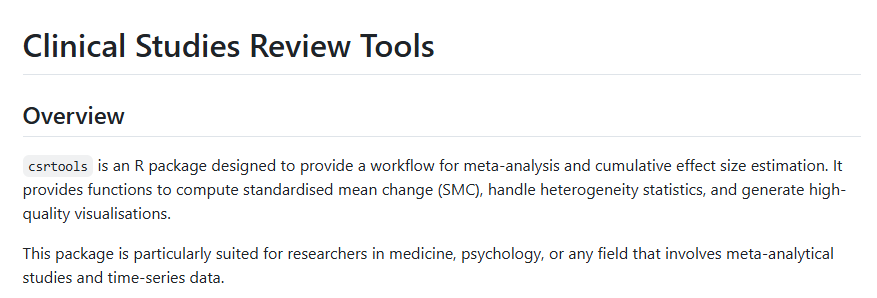
We developed csrtools, an R package designed to standardise a workflow for quantifying effect size and data visualisation for clinical study reviews.
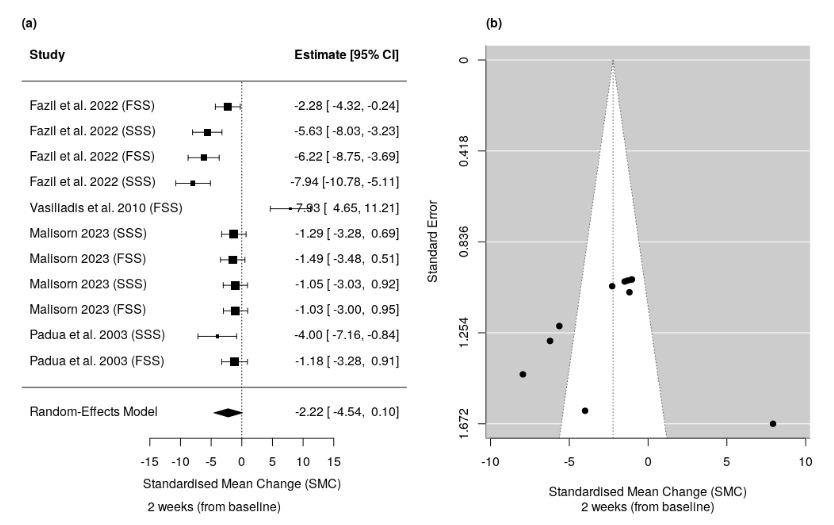
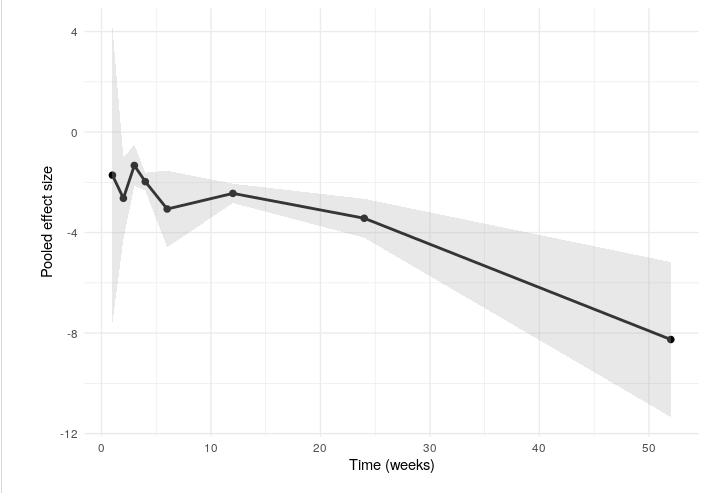
The package supports core tasks such as calculating standardised mean change, running pooled meta-analyses, extracting uncertainty statistics, producing forest and funnel plots, and ribbon plots illustrating cumulative standardised mean change through time.
Key outcomes
The two studies provided evidence on recovery trajectories following hand surgery procedures, supporting a clearer understanding of how patient-reported outcomes change over the weeks and months following surgical intervention.
Our work demonstrated the value of building reproducibility into the pipeline from the start. We developed the package initially for Hartrick et al. (2025). By developing a dedicated package, the workflow became easier to repeat and update. This made it easily transferrable to support further work, such as key analyses in Chong et el. (2026).
Transparency is particularly important for complex workflows such as meta-analyses, where analytical choices (e.g., how to handle missing data) can later influence interpretation. Reproducible workflows do not remove the need for expert judgement, but they make that judgement more visible.
Conclusions
Whether synthesising clinical studies or biodiversity evidence, researchers are often working with data that are fragmented or collected at cross-purposes. Both contexts require understanding what the evidence can reliably support, where uncertainty remains, and how results should be interpreted and acted on.
For us, our contributions to these important projects reflects a wider commitment to high-quality evidence synthesis. Whether supporting clinical research or conservation decision making, our aim is the same: to help organisations make better use of existing evidence while being clear about its strengths, limitations and communicating uncertainty.
Want to turn complex evidence into actionable insights?
At Empirical Nature, we support researchers and organisations through our Research and Knowledge Exchange services. We help with evidence synthesis and systematic review workflows, from data extraction and harmonisation to meta-analysis, uncertainty assessment and reproducible reporting.
References
- Chong, L. Y., Hartrick., O. J., Khatri, C., Sandhu, C., Bele, S., Rodrigues, J., & Harrison, C. (2026). Differences in recovery time between trapeziectomy and carpometacarpal joint replacement: meta-analysis, BJS Open, 10(2), zrag040, https://doi.org/10.1093/bjsopen/zrag040.
- Hartrick, O., Turner, R. K., Freethy, A., Khatri, C., Chong, L.,Wade, R. G., Wormald, J. C. R., Wiberg, A., Rodrigues, J. N., & Harrison, C. (2025). Time to recovery following open and endoscopic carpal tunnel decompression: meta-analysis, BJS Open, 9(4), zraf085, https://doi.org/10.1093/bjsopen/zraf085 .
- Turner, R., & Hartrick, O. (2025). csrtools: Clinical Studies Review Tools. https://doi.org/10.5281/zenodo.14841467.